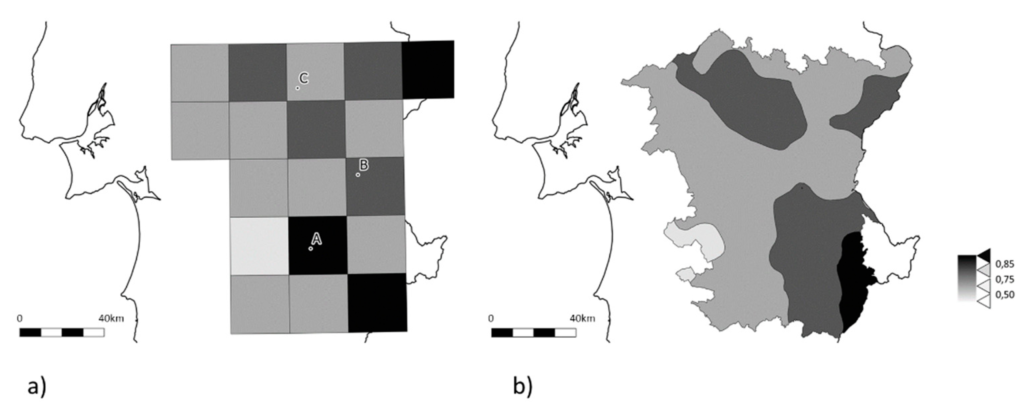
Figure 2. Schematic representation of OP resistance-associated alleles in the olive fruit fly based on 333 samples spread through 71 locations (see Figure 1b for details). (a) Observed frequencies by grid square; (b) Kriging estimated Alentejo region surface. The darker the gray, the greater is the proportion of OP resistance-associated alleles. White corresponds to the area with no data. (https://www.mdpi.com/2075-4450/10/8/232)
Margaritopoulos JT, Skavdis G, Kalogiannis N, Nikou D, Morou E, Skouras PJ, Tsitsipis JA, Vontas J: Efficacy of the pyrethroid alpha-cypermethrin against Bactrocera oleae populations from Greece, and improved diagnostic for an iAChE mutation. Pest Manag Sci 2008, 64:900-908. http://onlinelibrary.wiley.com/doi/10.1002/ps.1580/abstract
Kakani EG, Zygouridis NE, Tsoumani KT, Seraphides N, Zalom FG, Mathiopoulos KD: Spinosad resistance development in wild olive fruit fly Bactrocera oleae (Diptera: Tephritidae) populations in California. Pest Manag Sci 2010, 66:447-453. http://onlinelibrary.wiley.com/doi/10.1002/ps.1921/full
Broumas T, Haniotakis G, Liaropoulos C, Tomazou T, Ragoussis N: The efficacy of an improved form of the mass-trapping method, forthe control of the olive fruit fly, Bactrocera oleae (Gmelin) (Dipt., Tephritidae): pilot-scale feasibility studies. J Appl Entomol 2002, 126:217-223. http://onlinelibrary.wiley.com/doi/10.1046/j.1439-0418.2002.00637.x/abstract
Noce ME, Belfiore T, Scalercio S, Vizzarri V, Iannotta N: Efficacy of new mass-trapping devices against Bactrocera oleae (Diptera tephritidae) for minimizing pesticide input in agroecosystems. J Environ Sci Heal Part B 2009, 44:442-448. http://www.tandfonline.com/doi/abs/10.1080/03601230902935105?journalCode=lesb20
Nogales* A, Nobre* T, Valadas V, Ragonezi C, Döring M, Polidoros A, Arnholdt-Schmitt B: Can functional hologenomics aid tackling current challenges in plant breeding? Brief Funct Genomics 2015:elv030. https://doi.org/10.1093/bfgp/elv030
Margulis L: Symbiosis in Cell Evolution: Microbial Communities in the Archean and Proterozoic Eons. Freeman; 1992
Humphreys CP, Franks PJ, Rees M, Bidartondo MI, Leake JR, Beerling DJ: Mutualistic mycorrhiza-like symbiosis in the most ancient group of land plants. Nat Commun 2010, 1:103. https://www.nature.com/articles/ncomms1105
Poulsen M, Hu H, Li C, Chen Z, Xu L, Otani S, Nygaard S, Nobre T, Klaubauf S, Schindler PM, Hauser F, Pan H, Yang Z, Sonnenberg ASM, de Beer ZW, Zhang Y, Wingfield MJ, Grimmelikhuijzen CJP, de Vries RP, Korb J, Aanen DK, Wang J, Boomsma JJ, Zhang G: Complementary symbiont contributions to plant decomposition in a fungus-farming termite. Proc Natl Acad Sci U S A 2014, 111:14500-5. http://www.pnas.org/content/111/40/14500.abstract
Kounatidis I, Crotti E, Sapountzis P, Sacchi L, Rizzi A, Chouaia B, Bandi C, Alma A, Daffonchio D, Mavragani-Tsipidou P, Bourtzis K: Acetobacter tropicalis is a major symbiont of the olive fruit fly (Bactrocera oleae). Appl Environ Microbiol 2009, 75:3281-3288. http://aem.asm.org/content/75/10/3281.full
Andongma AA, Wan L, Dong Y-C, Li P, Desneux N, White JA, Niu C-Y: Pyrosequencing reveals a shift in symbiotic bacteria populations across life stages of Bactrocera dorsalis. Sci Rep 2015, 5:9470. https://www.nature.com/articles/srep09470
Kikuchi Y, Hayatsu M, Hosokawa T, Nagayama A, Tago K, Fukatsu T: Symbiont-mediated insecticide resistance. Proc Natl Acad Sci 2012, 109:8618-8622. http://www.pnas.org/content/109/22/8618
Otani S, Mikaelyan A, Nobre T, Hansen LH, Koné NA, Sørensen SJ, Aanen DK, Boomsma JJ, Brune A, Poulsen M: Identifying the core microbial community in the gut of fungus-growing termites. Mol Ecol 2014, 23:4631-4644. http://onlinelibrary.wiley.com/doi/10.1111/mec.12874/abstract
Crotti E, Balloi A, Hamdi C, Sansonno L, Marzorati M, Gonella E, Favia G, Cherif A, Bandi C, Alma A, Daffonchio D: Microbial symbionts: A resource for the management of insect-related problems. Microb Biotechnol 2012, 5:307-317. https://www.ncbi.nlm.nih.gov/pmc/articles/PMC3821675/
Nobre T, Koné NA, Konaté S, Linsenmair KE, Aanen DK: Dating the fungus-growing termites mutualism shows a mixture between ancient codiversification and recent symbiont dispersal across divergent hosts. Mol Ecol 2011, 20:2619-2627. http://onlinelibrary.wiley.com/doi/10.1111/j.1365-294X.2011.05090.x/abstract
van Asch B, Pereira-Castro I, Rei F, da Costa LT: Mitochondrial haplotypes reveal olive fly (Bactrocera oleae) population substructure in the Mediterranean. Genetica 2012, 140:181-187. https://link.springer.com/article/10.1007/s10709-012-9669-2
Hermoso M, Uceda M, Frias L, Beltrán G: Maduración. El Cultiv del olivo 2001, 2.
Ramírez E, Medina E, Brenes M, Romero C. Endogenous enzymes involved in the transformation of oleuropein in Spanish table olive varieties. J Agric Food Chem. 2014;62: 9569-9575. doi:10.1021/jf5027982. http://pubs.acs.org/doi/abs/10.1021/jf5027982
Estes AM, Hearn DJ, Bronstein JL, Pierson EA: The olive fly endosymbiont, “Candidatus Erwinia dacicola” switches from an intracellular existence to an extracellular existence during host insect development. Appl Environ Microbiol 2009, 75:7097-7106. http://aem.asm.org/content/75/22/7097.full
Blow F, Gioti A, Starns D, Ben-Yosef M, Pasternak Z, Jurkevitch E, Vontas J, Darby AC: Draft Genome Sequence of the Bactrocera oleae Symbiont “Candidatus Erwinia dacicola”. Genome Announc 2016, 4:e00896-16. https://www.ncbi.nlm.nih.gov/pmc/articles/PMC5026430/
Jovel J, Patterson J, Wang W, Hotte N, O?Keefe S, Mitchel T, Perry T, Kao D, Mason AL, Madsen KL, Wong GKS: Characterization of the gut microbiome using 16S or shotgun metagenomics. Front Microbiol 2016, 7(APR):1-17. https://www.ncbi.nlm.nih.gov/pmc/articles/PMC4837688/